A few more months grandest World Cup performances will be held soon. Southern African countries as the steering unsparing to prepare for this event as vibrant as possible. Can be seen from the preparation of the stadium that will be used by 32 countries competed. The following statistic data of the 10 stadiums to be used in a game later.
 Soccer City Stadium
City: Johannesburg
When Built: 1987
Completed renovated: 2009
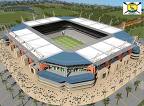
Seating capacity: 94,700As one of the most beautiful and magnificent stadiums in Africa, Soccer City Stadium, will be the place digelarnya first World Cup match between South Africa in 2010 against Mexico, as well as to the ultimate game in the first World Cup Final party at Black Continent. Basic design of the building works were inspired vase shape typical of Africa, known by the name 'Calabash' and its beauty will be increasingly reflected when illuminated at night.
Soccer City is located in Southwest Jonannersburg, near Sowetol, the city where 40 percent of residents live Johannersburg. Hence, the stadium will be the center of activities during the World Cup finals in 2010. Considered the heart of South African football as most important game in the history of South Africa played here.
Also in this stadium, Nelson Mandela was welcomed by the people of South Africa after being released from prison in 1990. Soccer City is the first international stadium is built in South Africa which was originally named FNB Stadium with a capacity of 80,000 people.
 Ellis Park Stadium
City: Johannesburg
When Built: 1982
Completed renovated: 2009
Seating capacity: 61,000
Located in downtown Johannesburg and experienced organizing Confederations Cup 2009 Final between Brazil and the United States, the stadium was originally built to hold a football game.
Taken from a board member JD Ellis, the stadium was built in 1982, occupied a special place in the hearts of the people of South Africa. That was where the 1995 South African rugby team won the Rugby World Cup after defeating New Zealand. At that time, Nelso Mandela lifted the trophy and unites people in celebration of that victory.
The stadium is equipped with facilities for disabled spectators, high-tech audio visual technology, and special places for the VIP audience. Ellis Park is the cage of a local club Orlando Pirates.
 Durban Stadium or Moses Mabhida Stadium
City: Durban
Finish Built: 2009
Seating capacity: 70,000
The new stadium is built it will become one of the organizers of the 2010 World Cup semi-final party. Characterize the giant buildings of architectural art and describes recent state flag at the southern tip of the African continent. Located in central Kings Park Sporting Precinct, the stadium has two curved lines on the roof which was then embedded in the main arch, symbolizing unity in a country that once divided by racial sentiments.
Seating capacity of 70,000, this stadium has multiple functions and features a cable car on the main arch and the stadium dwell bertinggi 350 meters 106 meters above the ground surface itun. From the cable car that will be seen a panoramic beach and town. Also the area around the stadium that will be used as support facilities such as restaurants, shops, kids playground, and walking the path that connects with the shore.
Moses Mabhida, whose name is used as the name of this stadium, is a political opponent of apartheid fighter and a politician leading the African National Congress, a revolutionary movement that won elections in 1994.
 Green Point Stadium
City: Cape Town
Finish Built: 2009
Seating capacity: 70,000
Built in the main port city, Cape Town, this stadium is one of the most admired websites in the city and will become a place pegelaran one party for the 2010 World Cup semi-final. Multipurpose stadium is located just a stone's throw from the beach, the mountains of Cape Town as a backdrop. In addition, a strategic location adjacent to the center for transportation. The stadium was also equipped with a silencer layer.
 Loftus Versfeld Stadium
City: Tshwane / Pretoria
Built: 1906
Completed renovated: 2008
Seating capacity: 50,000
As one of the oldest stadiums in South Africa, various events have been held here since 1903, while the first concrete structure which can accommodate 2000 people was built by the city council in 1923. The stadium continues to be improved since the year 1948 and used for rugby and football matches, even in 1995 became the pretext of Rugby World Cup and African Nations Cup in 1996. Loftus Versfeld Stadium is where the national team beat South Africa for the first European country, Sweden, in 1999.
 Free State Stadium
City: Mangaung / Bloemfontein
Start Built: 1952
Completed renovated: 2008
Seating capacity: 48,000
Enclosure of some of the local football club will become the focus of the World Cup later. This is where the Spanish team, winning the first Cup in 2009 are surprisingly Kondfederasi fallen from U.S. national team in the semi-final match.
Bloemfontein residents known to the spirit of sports, while sports center in their town has become an arena of several national sports competitions, especially rugby and football.
 Nelson Mandela Bay Stadium or Port Elizabeth Stadium
City: Nelson Mandela Bay or Port Elizabeth
Finish Built: 2009
Seating capacity: 48,000
Nelson Mandela Bay Stadium was built on the shores of North End Lake and will be host to seize third place match, the quarterfinals, and the other six games during the World Cup in 2010. Has a unique roof structure and a beautiful background for pemandangn near North End Lake. Previously, all matches played football in this town in Eastern Province rugby stadium, South Africa.
 Peter Mokaba Stadium
City: Polokwane
Finish Built: 2010
Seating capacity: 46,000
Named according to a fighter antiapartheid, Peter Mokaba stadium commemorate the spirit and inspiration of the warrior who is also from the city of Polokwane. The design of the stadium was inspired by a local symbol, Baobab trees, the structure of the steel columns supporting the roof in each corner.
Stadium, a distance of five kilometers from the town center was built near the old stadium Peter Mokaba in Limpopo Province. At the stadium, which is now defended Didier Drogba of Chelsea, made his first international debut for Ivory Coast at the African Nations Cup qualifier against South Africa.
 Mbombela Stadium
City: Nelspruit
Finish Built: 2009
Seating capacity: 46,000
This includes the new stadium was built to welcome the World Cup in 2010. It took its name from the name of the town of Nelspruit and Mbolela derived from the Siswati language (one of the official languages of South Africa), literally meaning "lots of people gathered in a small place." Situated in Mpumalanga Province, the stadium is about eight miles from downtown and 12 kilometers from Kruger-Mpumalanga Airport.
 Royal Bafokeng Stadium
City: Rustenburg
Starting Built: 1999
Completed renovated: 2010
seating capacity: 42,000
The stadium was named after the Bafokeng tribe settled in the area. Although Rustenberg has no local club, but the stadium has played host to the local football leagues (Premier Soccer League) and when South Africa beat Burkina Faso 2-1 in World Cup qualifying match in 2001. The stadium is located 25 kilometers from downtown Rustenberg.
Read More..

 Raden Ajeng Kartini was born in 1879 in the town of Apex. He is son of a nobleman who was very obedient to the customs. After graduating from elementary school he was not allowed to continue their education to higher levels by the parents. He secluded while waiting time to wed. Small Kartini was very sad with this, he wanted to resist but did not dare for fear of being children of disobedience.